


The Award-Winning Campaign
Viagra’s “Make Love Last” campaign by Ogilvy Health Shanghai just won the 2025 Cannes Lions Pharma Grand Prix, the advertising industry’s highest honor for pharmaceutical marketing. The campaign featured three real couples sharing intimate stories about relationship challenges, captured through time-lapse photography over four hours (Viagra’s duration of effectiveness) to create abstract trails of light visualizing lasting intimacy (Ads of the World, 2025).
Franklin Williams, the Pharma Lions jury president, explained the victory: “This piece stood out by saying everything without needing to say a word. Its long-exposure technique delivered intimacy and product benefit with breathtaking subtlety” (Cannes Lions, 2025a).
Breaking Medical Marketing Barriers
China’s Strict Pharmaceutical Advertising Laws
China maintains some of the world’s most restrictive pharmaceutical advertising regulations, fundamentally different from markets like the United States. Direct-to-consumer advertising of prescription drugs is prohibited (CMS Law, 2024; Lexology, 2023), and prescription drugs shall not be advertised on mass media or promoted in any other manner targeting the public (CMS Law, 2024).
Why Viagra Specifically Was Restricted
Viagra (sildenafil) is a prescription medication in China, which means it falls under the blanket ban on direct-to-consumer advertising of prescription drugs. The key restriction isn’t about the type of drug Viagra is, but rather its prescription status.
Prescription Drug Restrictions: Prescription drugs may be advertised in medical or pharmaceutical journals jointly approved by the National Health Commission and NMPA (CMS Law, 2024), but cannot be promoted directly to consumers through mass media, social platforms, or public advertising.
Content Restrictions: Even when advertising to healthcare professionals, pharmaceutical advertisements must not contain comparisons with other products, promises of recovery after medical treatment, or paid endorsements from pharmaceutical professionals (Sekkei Digital Group, 2024).
Pre-Approval Requirements: Under the PRC Drug Administration Law, all pharmaceutical advertisements must undergo a pre-approval process by a provincial-level government (Sekkei Digital Group, 2024).
The Viagra Campaign’s Ingenious Solution
The campaign’s genius lies in how it navigated these restrictions. By creating an unbranded art project launched on Chinese Valentine’s Day, Viatris sparked organic conversations about intimacy while remaining fully compliant with regulations (WPP, 2025). Rather than promoting Viagra directly to consumers (which would violate prescription drug advertising laws), the campaign focused on relationship wellness and emotional intimacy topics outside the scope of pharmaceutical advertising restrictions.
The release of this advertisement could not come soon enough. With ED affecting between 3-77% of the male population worldwide, there is a great need for patients to feel comfortable speaking about their sexual health with healthcare providers.
Erectile Dysfunction Stats by Age, Region, and Severity
Erectile dysfunction affects millions of men globally, with comprehensive research showing prevalence varies significantly by age, region, and underlying health conditions. The most recent data reveals ED is far more common than previously understood.
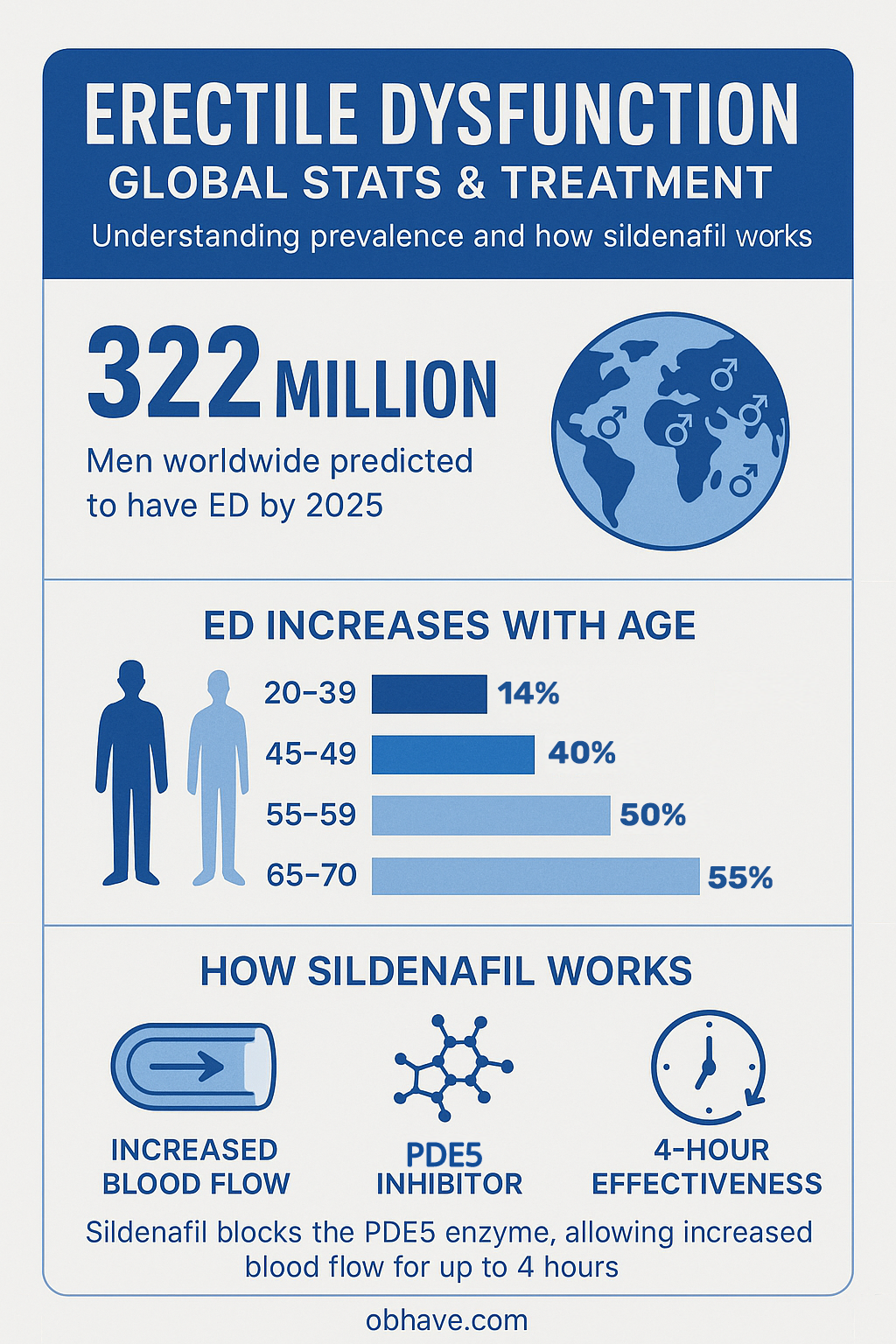
Erectile Dysfunction Prevalence by Age (Worldwide)
| Age Group | ED Prevalence | Source |
|---|---|---|
| 18-30 years | 14% | Journal of Urology, 2021 |
| 30-39 years | 11% | SingleCare, 2024 |
| 40-49 years | 40% | Translational Andrology and Urology, 2017 |
| 50-59 years | 50% | Translational Andrology and Urology, 2017 |
| 65-74 years | 48% | Journal of Sexual Medicine, 2024 |
| 75+ years | 52% | Journal of Sexual Medicine, 2024 |
Erectile Dysfunction Increases with Age
The data reveals a dramatic age-related increase in erectile dysfunction prevalence, with rates rising from single digits in young men to affecting approximately half of older men. Among younger populations, ED affects 8-14% of men in their twenties and thirties, representing a relatively small but clinically significant portion. The most striking increase occurs between the thirties and forties, where prevalence jumps from 11% to 40% nearly quadrupling in a single decade. This steep rise continues into the fifties, reaching 50% prevalence, meaning half of all men in this age group experience some degree of erectile dysfunction. The prevalence remains high in the oldest age groups, with 48% for men aged 65-74 and 52% for those 75 and older.
General ED Prevalence by Region/Country
| Region/Country | ED Prevalence (Age-Adjusted) | Source |
|---|---|---|
| Global Range | 3%-77% | Kessler, 2019 |
| Latin America | 14–55.2% | Gutierrez-Velarde et al., 2023; Santillán-Romero et al, 2024 |
| United States | 20.7–57.8% | Journal of Sexual Medicine, 2024 |
| Europe | 10–76.5% | Kessler, 2019 |
| Canada | 49.40% | WHO EMRO |
| Asia | 8–71.2% | WHO EMRO |
| Middle East | 23.8% | WHO EMRO |
| Africa | 9.1% to 36.4% | WHO EMRO |
| Oceania | 40.3% and 60.69% | WHO EMRO |
Substantial Variation in Prevalence of ED by Region
These age-adjusted prevalence rates for men aged 40-50 reveal significant global variation in erectile dysfunction, with rates ranging from as low as 3% to as high as 77% depending on the region and study. Africa shows a relatively narrow range (9.1-36.4%), while Europe demonstrates the widest variation (10-76.5%). Asia displays substantial heterogeneity (8-71.2%), and North America shows considerable variation as well, with Canada reporting 49.4% compared to the United States’ range of 20.7-57.8%. Latin America ranges from 14-55.2% and Oceania from 40.3-60.7%, while the Middle East, represented by Qatar, shows 23.8%. The data reveals there is substantial variation in the prevalence of ED requiring further analysis of the severity of ED which may contribute to the variation.
ED Severity Distribution (Massachusetts Male Aging Study)
| Severity Level | Prevalence | Clinical Definition |
|---|---|---|
| Any degree of ED | 52% | Any reported erectile difficulty |
| Minimal ED | 17% | Slight, intermittent, or irregular loss of penile rigidity |
| Moderate ED | 25% | Increasing degree of loss of penile rigidity with adverse effect on erectile functional capabilities |
| Complete ED | 10% | Complete inability to achieve or maintain erection suitable for sexual intercourse |
The Massachusetts Male Aging Study examined men aged 40-70 years in the Boston area and found that 52% experienced some degree of erectile dysfunction. The study participants were from the general population.
Age-Related ED Prevalence in the Massachusetts Male Aging Study
- The incidence rate increased dramatically with age: 12.4 cases per 1,000 men for men aged 40-49, 29.8 for men aged 50-59, and 46.4 for men aged 60-69
- Complete ED prevalence tripled from 5% at age 40 to 15% by age 70
ED Comorbidity Status
While this was a general population sample, the study did identify significant associations between ED and various health conditions including:
- Diabetes: 66% of men with diabetes experience ED (BMC Public Health, 2024; Faulkner et al., 2015)
- Chronic kidney disease: 80% experience some level of ED (World Journal of Nephrology, 2014)
- COPD: 72%-87% of men experience ED (Journal of Clinical Medicine, 2021)
- Obesity: 79% of men with ED are overweight (BMI ≥25) (Polski Merkuriusz Lekarski, 2014)
However, the 52% overall prevalence and the severity breakdown (17% minimal, 25% moderate, 10% complete) represents the general male population aged 40-70, not specifically men with comorbidities. This makes the high prevalence rates particularly notable, as they demonstrate that ED is common even in the broader population, not just among men with diagnosed health conditions. The study’s strength lies in its random sampling methodology, providing population-level estimates rather than clinical estimates.
Key Global Statistics for Erectile Dysfunction
- Total affected: Up to 77% of men worldwide may experience ED challenges (SingleCare, 2024)
- US cases: Approximately 18 million men in the United States (Johns Hopkins, 2007)
- Lifetime risk: 1 in 10 men estimated to have ED at some point (Cleveland Clinic, 2019)
- Treatment gap: Only 25% of men with ED receive treatment (Journal of Sexual Medicine, 2014)
Why This Matters Beyond Advertising
This campaign represents a cultural milestone in healthcare communication. By celebrating vulnerability and emotional connection, it challenges traditional masculine stereotypes around sexual performance and encourages men to view ED as a treatable health condition rather than personal failing. The approach also demonstrates how regulatory constraints can fuel innovation. When direct pharmaceutical advertising is prohibited, creative teams must find new ways to connect with patients, often resulting in more authentic, human-centered communication.
Cultural Shift in Health Communication
The campaign’s victory signals growing social acceptance of intimate health discussions. By treating ED as a relationship challenge rather than individual shame, it reframes the condition as a shared human experience. This shift reflects broader societal movements toward mental health awareness, destigmatization of medical conditions, and recognition that emotional wellness is integral to physical health outcomes.
Impact on Medical Practice
Healthcare providers are increasingly recognizing the significant role of emotional and psychological factors in erectile dysfunction and are integrating psychosocial approaches into treatment plans. Research demonstrates that psychological factors can both cause and worsen ED, while experiencing ED can lead to anxiety, depression, and decreased self-esteem, creating a destructive cycle (American Urological Association, 2018).
Studies show that combining medical treatments with psychological therapies is more effective than either approach alone, with cognitive behavioral therapy improving treatment adherence and relationship satisfaction (Journal of Sexual Medicine, 2019). The campaign suggests patients may be more receptive to treatment discussions that acknowledge relationship dynamics and emotional wellness, not just pharmaceutical intervention.
Looking Forward
The “Make Love Last” victory suggests the future of pharmaceutical marketing lies in emotional authenticity rather than clinical presentations. As the campaign’s influence spreads globally, it may inspire healthcare providers to adopt more relationship-focused communication strategies and encourage other pharmaceutical companies to prioritize patient experience over product features.
For urologists and sexual health specialists, this cultural shift toward openness presents an opportunity to have more meaningful conversations with patients about the emotional and relational aspects of sexual health ultimately leading to better treatment outcomes and reduced healthcare stigma.
The success of emotional storytelling over clinical data could inspire similar approaches for other sensitive health conditions, from mental health to reproductive issues. This model demonstrates that effective health communication can address both medical symptoms and the human experience of illness, potentially transforming patient engagement across multiple therapeutic areas.
References
- Ads of the World. (2025, May). Viatris: Make Love Last. https://www.adsoftheworld.com/campaigns/make-love-last
- BioSpace. (2024, July 15). Erectile Dysfunction Market to Reach USD 3.9 Billion by 2034. https://www.biospace.com/erectile-dysfunction-market-to-reach-usd-3-9-billion-by-2034
- Cannes Lions. (2025a, June 17). First winners announced at the 72nd Cannes Lions International Festival. https://www.canneslions.com/news/first-winners-announced-at-the-72nd-cannes-lions-international-festival
- Market.us. (2025, March 19). Erectile Dysfunction Drugs Market Size | CAGR of 9.2%. https://market.us/report/erectile-dysfunction-drugs-market/
- WPP. (2025, June 19). Ogilvy: Viatris’ Make Love Last. https://www.wpp.com/en-us/featured/work/2025/06/ogilvy-viatris-make-love-last